 English
 français
 Deutsch
 Español
 italiano
 русский
 português
 العربية
 ไทย
ไทย čeština
 Polska
In 2026, industrial procurement teams are evaluating pump seals against a broader set of KPIs than leakage prevention alone. Energy consumption per operating hour, carbon reduction targets, maintenance labor cost, shaft wear frequency, and total cost of ownership are now core purchasing criteria—and they are increasingly tied to corporate ESG commitments and regulatory reporting obligations. A high-quality rubber bellow mechanical seal, also known as an elastomer bellows seal, addresses several of these KPIs simultaneously: it reduces shaft fretting risk, compensates for misalignment without sliding contact along the shaft, simplifies installation, and supports more stable long-term sealing performance across centrifugal pumps, water pumps, circulation pumps, submersible pumps, and other rotating equipment.
Sealcon describes elastomer bellow mechanical seals as compact, easy to install, cost-effective, versatile, and non-directional—suitable for use regardless of shaft rotation direction, with driving torque transmitted through the interference fit between the collar, rubber bellow, and shaft rather than through a single coil spring. For industrial buyers managing pump fleets where seal-related downtime, shaft damage, and energy waste are recurring cost drivers, this design logic translates directly into measurable operational savings.
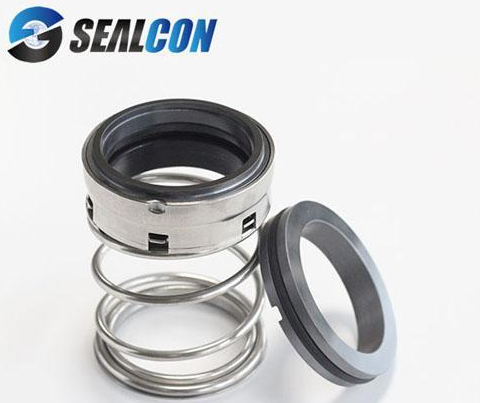
Why Rubber Bellow Seals Matter for Energy-Efficient Mechanical Seals
The energy efficiency argument for rubber bellow seals starts with understanding where friction losses originate in conventional mechanical seal designs.
In many traditional seal configurations, the compensation element—typically an O-ring or secondary sealing ring—must slide axially along the shaft or sleeve to maintain face contact as the seal faces wear or as the shaft moves. Over time, this sliding contact creates fretting damage on the shaft or sleeve surface. Fretting increases surface roughness, which in turn increases the friction required to maintain shaft rotation, raises local heat generation, and accelerates seal face wear. The cumulative effect is a gradual increase in mechanical drag, higher power consumption per operating hour, and more frequent seal and shaft replacement.
A rubber bellow seal eliminates this sliding contact mechanism. The elastomer bellows element provides axial flexibility through elastic deformation rather than sliding movement. The bellow grips the shaft through interference fit, transmits driving torque directly, and flexes to compensate for shaft runout, misalignment, and thrust movement—without requiring any sliding along the shaft surface.
The energy and reliability implications are direct:
No fretting damage at the shaft interface means the shaft surface remains smooth, reducing rotational friction over the seal's service life
More stable seal face loading from consistent bellows spring force reduces face wear rate and maintains sealing efficiency
Self-aligning capability absorbs small misalignment errors that would otherwise create uneven face loading, hot spots, and premature failure
Reduced maintenance intervention frequency lowers the labor cost and production downtime associated with seal replacement cycles
For plants operating large pump fleets on continuous duty—water treatment, HVAC circulation, chemical processing, wastewater management—the aggregate energy and maintenance saving from switching to properly specified energy-efficient mechanical seals can be significant over a 3–5 year operating horizon.
Working Principle: How Elastomer Bellows Reduce Shaft Wear and Friction
Understanding the mechanical logic of an elastomer bellows seal helps buyers evaluate whether it is the right solution for their specific pump and operating condition.
The seal assembly operates as follows:
The rotating assembly consists of the elastomer bellows, a spring, a seal face (rotating), and metal hardware. The bellows is pressed onto the shaft through interference fit—the elastic compression of the rubber creates the grip and torque transmission without requiring set screws or mechanical clamping in many designs. The stationary assembly consists of the seat ring, which is pressed or held in the seal chamber.
When the pump operates, the rotating seal face maintains contact with the stationary seat under the combined load of the spring force and the hydraulic pressure of the sealed fluid. The elastomer bellows flexes axially to accommodate:
Shaft runout (radial deviation during rotation)
Axial thrust movement (shaft movement along its axis)
Misalignment between the shaft centerline and the seal chamber axis
Gradual seal face wear over the service life
Because all of this compensation occurs through elastic deformation of the bellows—not through sliding contact—the shaft surface is protected from fretting. Sealcon specifically notes that the elastomer bellow protects the shaft and sleeve from fretting, and that shaft runout is compensated by the elastomer bellow and spring through the self-aligning capability.
Why this supports lower friction losses in practice:
A shaft surface damaged by fretting from a sliding O-ring seal develops micro-pitting and roughness that increases the friction coefficient at the seal interface. This friction manifests as additional mechanical load on the motor—measurable as increased current draw and heat generation. Over a long operating cycle, this friction penalty compounds. A rubber bellow seal that prevents fretting from the first installation maintains a lower friction baseline throughout its service life, supporting more consistent pump efficiency and lower energy consumption per unit of fluid transferred.
Key Specifications for Selecting a Rubber Bellow Mechanical Seal
Correct material and dimensional selection is the foundation of seal performance. A rubber bellow seal that is correctly sized and material-matched to the operating condition will outperform a premium seal that is incorrectly specified.
Shaft Size and Seal Geometry
Confirm shaft diameter in metric or inch dimensions—interference fit tolerances are tight, and incorrect sizing prevents proper grip and torque transmission
Confirm seal chamber bore and depth to ensure the assembly fits without modification
Identify the existing seal model if replacing an installed seal, to confirm dimensional compatibility
Seal Face and Seat Material
| Face/Seat Combination | Recommended Application |
|---|---|
| Carbon / Ceramic | Standard water, circulation, and general service |
| Carbon / SiC | Moderate abrasion, higher temperature service |
| SiC / SiC | Abrasive media, high-speed, demanding conditions |
| TC / TC | Highly abrasive or aggressive media |
Elastomer Bellow Material
| Bellow Material | Recommended Application |
|---|---|
| NBR (Nitrile) | General water, oil, and many industrial fluids |
| EPDM | Water, steam-compatible service, some chemical applications |
| Viton / FKM | Higher chemical resistance, elevated temperature service |
Spring and Metal Parts
SS304 for general service
SS316 for corrosive media, seawater, or chemical environments
Operating Condition Parameters
Maximum operating pressure and temperature
Shaft speed (RPM)
Fluid medium and any abrasive or chemical content
Continuous or intermittent duty cycle
Sealcon lists common material combinations including carbon, SiC, and TC seal faces; ceramic, SiC, and TC seats; NBR, EPDM, and Viton bellows; and SS304/SS316 spring and metal parts—covering the majority of standard industrial pump sealing requirements.
Application Scenarios: Where Rubber Bellow Seals Deliver the Strongest Industrial Seal ROI
Water Transfer and Municipal Water Systems Continuous-duty water transfer pumps benefit from the fretting protection and self-aligning capability of rubber bellow seals. Reduced shaft wear extends the interval between shaft sleeve replacements, which is one of the higher-cost maintenance events in large pump installations.
Sewage and Wastewater Pumps Wastewater pumps operate in abrasive, chemically variable media with frequent start-stop cycles that create axial shaft movement. The elastomer bellows compensates for this movement without sliding contact, reducing the seal failure rate that is common in wastewater applications with conventional O-ring designs.
Circulation Pumps in HVAC and Heating Systems Building HVAC circulation pumps run continuously for months at a time. Seal reliability directly affects system uptime and energy efficiency. A rubber bellow seal with stable face loading and fretting protection supports longer maintenance intervals and more consistent pump performance across the heating and cooling season.
Submersible Pumps Submersible pump seals operate under hydrostatic pressure and in environments where maintenance access is difficult and costly. The compact design and self-aligning capability of elastomer bellow seals make them a practical choice for submersible applications where seal replacement frequency must be minimized.
Chemical, Petroleum, and Refinery Pumps For pumps handling chemical media, the ability to select Viton/FKM bellows with SiC or TC face pairs provides the chemical resistance and wear resistance required for demanding process service. The non-directional design—which operates regardless of shaft rotation direction—simplifies inventory management for facilities with mixed pump configurations.
Auto Cooling and Fuel Injection Pumps The compact design and easy installation of rubber bellow seals make them suitable for automotive cooling and fuel system applications where space constraints and assembly speed are important.
Installation, Selection, Maintenance, and TCO: The Long-Term Savings Logic
Selection Workflow
Step 1 — Identify the pump and shaft parameters. Confirm shaft diameter, seal chamber dimensions, and the existing seal model if replacing an installed seal. Dimensional accuracy is critical for correct interference fit and torque transmission.
Step 2 — Define the medium and operating conditions. Water, wastewater, fuel, chemical liquid, oil, coolant, or process fluid. Confirm operating temperature, pressure, and shaft speed. These inputs determine the elastomer material, face pair, and metal part grade.
Step 3 — Select elastomer material based on chemical compatibility. NBR for general water and oil service; EPDM for water and steam-compatible applications; Viton/FKM for higher chemical resistance and elevated temperature service. Confirm compatibility with the specific fluid chemistry before ordering.
Step 4 — Select face and seat material based on wear and abrasion requirements. Carbon/ceramic for standard clean water service; carbon/SiC or SiC/SiC for moderate to high abrasion; TC/TC for highly abrasive or aggressive media.
Step 5 — Confirm spring and metal part grade. SS304 for general service; SS316 for corrosive, chemical, or marine environments.
Step 6 — Establish a maintenance tracking baseline. After installation, record leakage rate, power consumption, vibration level, and seal condition at each inspection. This data supports the ROI calculation and helps identify the optimal replacement interval before failure.
Maintenance and TCO Advantages
Reduced shaft and sleeve repair cost is the primary TCO driver for plants switching from sliding O-ring seals to rubber bellow designs. Shaft sleeve replacement is a labor-intensive, time-consuming maintenance event. Eliminating or significantly extending the interval between sleeve replacements reduces both direct material cost and the associated pump downtime.
Lower unplanned downtime cost from more stable seal performance. Rubber bellow seals with self-aligning capability are less sensitive to small installation errors and shaft condition variations than designs that depend on precise sliding contact. This robustness reduces the probability of early seal failure after installation.
Reduced energy consumption from lower friction at the shaft interface. While the per-seal energy saving is modest, across a fleet of continuously operating pumps, the aggregate reduction in mechanical drag translates into measurable electricity cost savings over a full operating year.
Simplified spare parts inventory from broad compatibility with common pump models. Sealcon's elastomer bellow seal range covers multiple shaft sizes and pump types, allowing maintenance teams to standardize on a smaller number of seal SKUs across a mixed pump fleet.
Lower-carbon pumping operations from the combination of reduced energy consumption, longer seal life, and fewer replacement events—each of which has an associated carbon cost in manufacturing, logistics, and installation labor.
Conclusion
In 2026, pump sealing is a measurable contributor to industrial energy efficiency, maintenance cost, and carbon performance. A properly selected rubber bellow mechanical seal reduces shaft fretting, compensates for misalignment through elastic deformation rather than sliding contact, and supports more stable long-term sealing performance—translating into lower friction losses, fewer unplanned shutdowns, and reduced shaft replacement frequency across centrifugal pumps, water pumps, circulation pumps, submersible pumps, and industrial process pumps.
Sealcon offers a wide range of elastomer bellows mechanical seals with multiple material combinations—NBR, EPDM, Viton bellows; carbon, SiC, TC faces; ceramic, SiC, TC seats; SS304/SS316 hardware—covering the majority of standard and demanding pump sealing requirements.
Visit the Sealcon Elastomer Rubber Bellow Mechanical Seals page to request a recommended seal configuration and quotation.
Please submit the following details for an accurate recommendation:
Work condition: Pump type, medium, operating temperature, pressure, shaft speed (RPM), continuous or intermittent duty
Quantity: Sample order, maintenance stock quantity, or annual demand
Size/spec: Shaft diameter, existing seal model, seal chamber dimensions, face and seat material preference, elastomer material, spring and metal part grade
Target metrics: Leakage reduction target, seal life target, maintenance frequency reduction, shaft wear reduction, energy saving goal
Current problems: Shaft fretting, leakage, short seal life, overheating, vibration, high maintenance cost, frequent unplanned pump downtime
FAQ
1. What is a rubber bellow mechanical seal?
A mechanical seal that uses an elastomer bellows as the secondary sealing and axial compensation element. The bellows grips the shaft through interference fit, transmits driving torque, and flexes to compensate for shaft runout, misalignment, and thrust movement—without requiring sliding contact along the shaft surface.
2. Rubber bellow seal vs. O-ring mechanical seal: which is better?
Rubber bellow seals are preferred when shaft fretting, misalignment compensation, and installation simplicity are priorities. O-ring seals can perform well in many applications, but designs that rely on sliding O-ring compensation along the shaft may cause fretting damage over time, particularly in continuous-duty or variable-load applications. The best choice depends on the pump type, operating condition, and maintenance history.
3. What is the ROI of energy-efficient mechanical seals?
ROI comes from reduced shaft and sleeve repair cost, lower unplanned downtime, longer seal service life, reduced friction-related energy consumption, and simplified spare parts inventory. The largest savings typically come from avoiding unplanned shutdowns and shaft replacement events rather than from the seal unit cost itself.
4. Do rubber bellow seals require pump modification?
Generally no. Most rubber bellow seals are designed as drop-in replacements for common pump seal configurations. Buyers should confirm shaft diameter, seal chamber dimensions, seat type, and operating conditions before ordering to ensure dimensional and material compatibility.
5. What parameters are needed for correct seal selection?
Pump model and type, shaft diameter, seal chamber dimensions, existing seal model (if replacing), process medium, operating temperature and pressure, shaft speed (RPM), duty cycle, required elastomer material, seal face and seat material preference, and the current failure mode such as leakage, fretting, overheating, or short service life.
-
China Water Pump Spare Parts: Complete Guide to Water Pump Components and Parts List
-
Different Types of Pump Seals: A Complete Guide to Pump Mechanical Seal Types
-
Mechanical Seal Stationary Seat: Complete Guide to Stationary Parts Sealing and Seal Seat Selection
-
Flygt Pump Mechanical Seal Installation Guide: Choosing Compatible Replacement Seals for Flygt Pumps
-
Sealing Sense
-
Classification Of Rubber Seal Ring